This guide explains how to plan a wedding step by step: confirm the budget and who is paying first, then lock the guest list, date and venue, and book vendors who work one wedding a day before caterers and florists.
The first decision is financial: who is contributing, and what the day should realistically cost where you are marrying. After that, this guide works as a decision tree. Choose the branch that matches your situation, then follow it through budget, guests, venue, timeline and vendors. A dated task list to run alongside it is in The Ultimate 12-Month Wedding Planning Checklist: Stress-Free Steps To Your Perfect Day (2026 Edition) – Invitingoccasion.
Pick your starting branch
Couples rarely begin from the same position, so the right first step depends on what is already fixed. Use the situation that sounds most like yours, and treat the other branches as a reminder of what will need deciding later.
- You have no number in mind yet. Begin with the budget section below. Every later choice, from venue size to entertainment, is priced against that total, so deciding it first keeps the rest in proportion.
- A date is already fixed. Go straight to the guest list and venue availability. A fixed date narrows which venues and vendors are open, and a wedding photographer’s planning guide points out that there are only so many wedding days in a year, so popular vendors book up quickly.
- You have less than a year. A compressed schedule is common: 2023 wedding statistics show 70% of couples planned in under 12 months. Book the vendors who can cover only one wedding per day first, then work through the rest.
- You want to marry away from home. Travel adds decisions about guests and logistics, so read how to plan a destination wedding alongside this guide and keep the budget-first order.
- A venue has already caught your eye. Ask about its availability and pricing before anything else. If it cannot take your date or your guest count, return to the guest list and date sections and widen the search.
All of these branches converge on one sequence. The sections below follow the order in which each decision limits the next, beginning with money.
Set the budget and name who is paying
A wedding budget starts with people, not percentages. Until you know who is contributing and how much, no vendor quote can be judged as affordable or not.
Confirm who is contributing
The planning guide from a wedding photographer advises finding out who will help pay for things before you total the budget. Hold that conversation before any deposit is paid. The amount available sets every later limit, and it is far easier to adjust a guest list or venue shortlist on paper than after a contract is signed.
Estimate what things cost near you
The same guide suggests researching what everything costs in your area, or using an online wedding budget calculator. A practical sequence:
- Write down every contributor and the amount each expects to give.
- Collect local price ranges for the venue, catering and photography, which are the largest lines.
- Run those ranges through a budget calculator to see how they stack up against your total.
- Leave room for items you have not priced yet, and adjust the total or the guest count before booking anything.
Use national averages as anchors only
Published averages are useful for sense-checking, not for setting a target. A 2023 wedding statistics roundup puts the average US wedding at $35,000, up 14% from the prior year, while a Zola planning guide quotes an average cost of $29,195. The gap between the figures is a reason to lean on local quotes rather than any single national number.
Location changes the picture further. The same 2023 roundup reports that 75% of couples in urban areas spent over $40,000, compared with $25,000 in rural areas. If you are marrying in a large city, expect your own quotes to sit above a national average; if you are marrying somewhere rural, they may sit below it.
Divide what is left after the venue
Zola’s planning guide says the venue will likely be your biggest investment, and suggests dividing the remaining funds across catering, rings, photography, flowers and music. That order is sound: fix the venue line, then share what remains by what matters most to you. A couple who cares most about food can accept simpler flowers; a couple who wants a dance floor all night can put more behind entertainment. The category figures in the overview table further down show which lines tend to take the largest slices.
Build the guest list and choose the date
The guest list and the date are linked decisions, and both must be settled before a venue can be booked with confidence.
Draft the list together
Sit down with your partner, and possibly both sets of parents, and write out a general list, as the photographer’s planning guide recommends. A rough list is enough at this stage; its job is to give you a headcount range for venue shortlisting and a number for catering estimates.
For context, the 2023 statistics roundup reports an average US guest count of 116, down 10% from 2019, and says 72% of 2023 weddings had 100 to 150 guests. If your list lands well above that band, the budget and venue branches will tighten quickly. If it lands below, you have more freedom to choose a smaller or more unusual space. Once replies come in, how to make a wedding seating chart covers the next step.
Weigh the date
The photographer’s guide lists the factors to consider: the time of year and weather, whether important guests can attend, how the date affects your budget, and whether venues are available. Rank them before you start. A couple with relatives travelling from far away may put guest availability first; a couple planning an outdoor ceremony may put season first. Whichever you choose, keep two or three candidate dates in hand when you contact venues, because your first choice may already be taken.
Choosing a wedding venue
Book the venue early in the sequence because it anchors the date, the guest count and a large share of the budget. Venue rental was the largest single expense in the 2023 data from the statistics roundup, and Zola’s guide also expects it to be the biggest investment.
When to book
Lead times vary widely. A wedding planning guide from a venue business notes that some venues may be booked 12 months or more in advance. The photographer’s guide describes the same spread from the vendor side: some couples book him two years ahead and others three months before the wedding. The practical reading is that a popular venue or a sought-after date calls for starting as soon as budget and guest count are roughly known, while a flexible date leaves more venues open.
What to compare
Quotes are only comparable when they cover the same things. Ask each venue the same questions:
- Capacity against your list. Compare the room’s seated capacity with the headcount range from your draft guest list, not with a hoped-for number.
- What the rental includes. Find out which hours, tables, chairs and staff are covered and which are extra.
- Vendor rules. Ask whether the venue supplies its own caterer or lets you choose, since that affects the catering line directly.
- Weather and backup plans. For any outdoor space, ask what happens if the forecast turns.
Indoor, outdoor or a mix
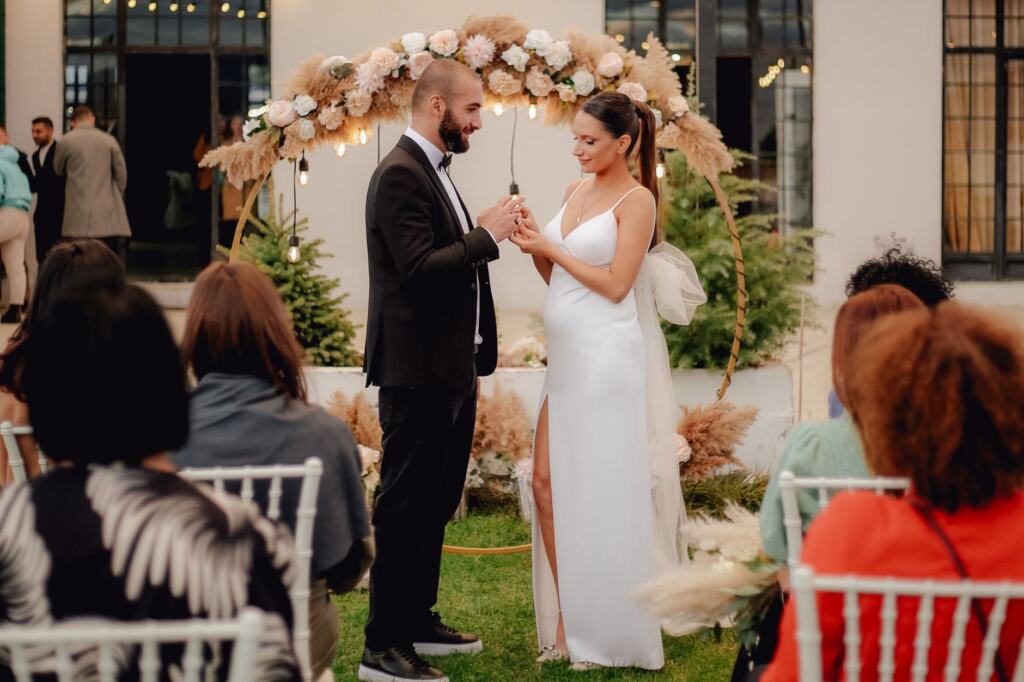
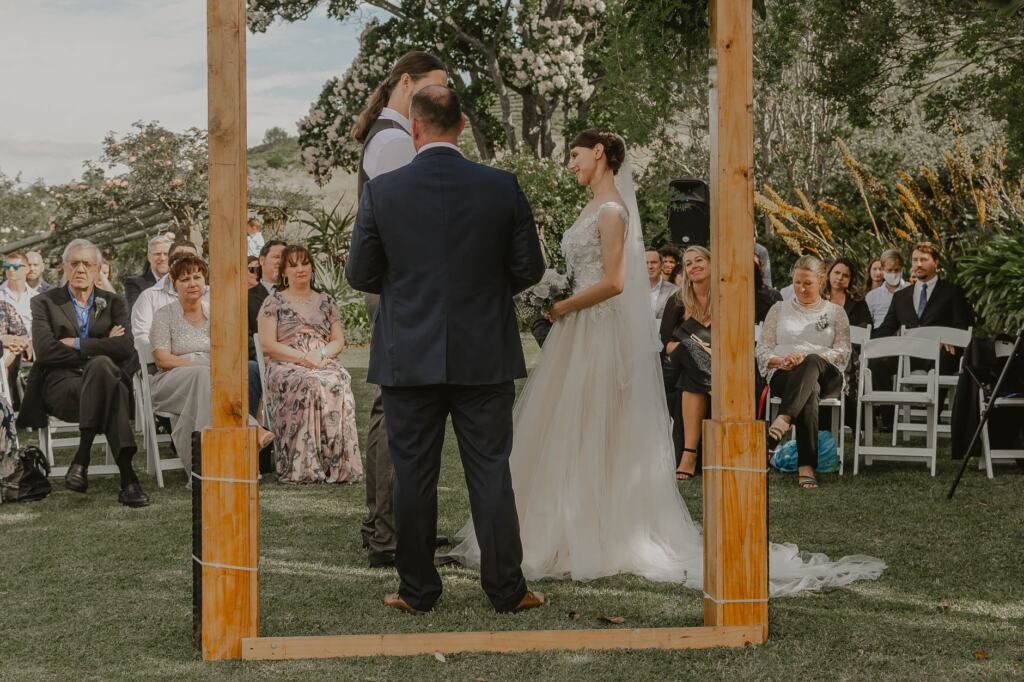
Choose by weather tolerance and guest comfort. An outdoor ceremony suits couples whose date falls in a season they trust and who have a backup space available. An indoor room suits couples marrying in less predictable weather or planning a long evening. A mix, with the ceremony outside and the reception indoors, gives scenery without staking the whole day on the forecast, though it means checking that the venue can manage the move between spaces.
Building the planning timeline
A wedding timeline works best as a schedule you build backward from the date, with a target date attached to every task.
Work backward from the date
The photographer’s guide recommends breaking down everything you need to do and setting goals for when each item should be done. Doing so turns a vague to-do list into a sequence you can check. How much time you have is the main variable: the 2023 statistics roundup reports an average engagement of 15 months for 2023 weddings, and Baywood’s planning guide likewise says most couples are engaged 15 months before the wedding, citing a 2019 study from The Knot. That is a reference point, not a requirement; shorter schedules work when the early decisions are made quickly.
The order of stages
Rather than counting months, follow the stages. Each one tends to be possible only after the one before it.
- Right after the engagement: confirm contributors, set the budget, draft the guest list and shortlist dates.
- Once a date is in view: book the venue, then the vendors whose calendars fill fastest, and hire a coordinator or planner if you want one.
- Mid-planning: book the vendors who can take more than one wedding per day, including the caterer and florist, and settle entertainment.
- Invitation stage: Baywood’s guide says invitations should go out six to eight weeks in advance, so have wording, addresses and the guest list finalised before then. The The Complete Wedding Invitation Timeline: When To Design, Send, And Track RSVPs (2026 Planner) – Invitingoccasion covers the design, sending and tracking sequence in more detail.
- Final stretch: confirm every vendor, finish the seating plan and write the schedules for the day.
Plan the day itself
Once the big bookings are made, shift attention to the order of events on the day. The Perfect Wedding Ceremony Timeline: Plan Every Moment Without Stress (2026 Guide) – Invitingoccasion breaks down the ceremony, What Is a Wedding Reception Timeline? The 2026 Guide To Planning A Smooth Evening – Invitingoccasion covers the reception, and The Perfect Wedding Day Timeline: An Hour‑By‑Hour, Stress‑Free Plan For 2026 – Invitingoccasion joins everything into a single schedule for the day.
Vendors to book and in what order
Book the vendors who can cover only one wedding per day first, because their calendars fill fastest. The photographer’s planning guide notes that caterers and florists can usually be booked later because they normally handle more than one wedding per day. That single rule sorts most of the vendor list.
The vendor checklist
- Venue. Book first, once date and headcount are roughly settled, as covered above.
- Photographer. Compare packages by what coverage includes, and ask early how many events the photographer takes on your date.
- Coordinator or planner. The photographer’s guide advises hiring your coordinator as early as possible, since a planner can help with the vendor decisions that follow. Weigh the fee, shown in the table below, against how much of the work you want to handle yourselves.
- Caterer. Catering is priced per guest, so your headcount flows straight into this line. It can be booked after the earlier priorities.
- Florist. Also able to book later, so settle venue and colour direction first.
- Entertainment. Choose between a DJ and a live band on price, space and the atmosphere you want. For options beyond music, see Unforgettable Wedding Reception Entertainment Ideas For 2026 (Creative, Budget-Friendly, And Crowd-Pleasing) – Invitingoccasion.
Who should hire a planner
A planner suits couples with a large guest list, a tight timeline or a destination, since those add vendor coordination. A couple with a small list and a venue that includes coordination may manage without. Either way, decide before the venue is booked, because an early hire can help compare venue offers.
Wedding costs by category
The table lists 2023 average costs for the main vendor lines and what each means for your budget.
| Category | 2023 average | Planning use |
|---|---|---|
| Venue rental | $10,000; 25-30% of total budget; largest single expense | Fix this line first, since it shapes how much remains for everything else. |
| Catering | $120 per guest; $15,600 for a 130-person event | Multiply your own headcount by quoted per-guest prices; the guest count drives this line. |
| Photographer | $6,000; 12-15% of total budget | Protect this line if photographs matter most to you, and book early. |
| Wedding planner (full-service coordination) | $2,500; about 15% of total budget | Compare against the time and stress you would otherwise spend coordinating vendors. |
| DJ | $1,500 | A lower-cost option for music and announcements. |
| Live band | $4,000 | Choose when live music is a priority, and fund it by trimming other lines. |
These are 2023 averages from a wedding statistics roundup; local quotes and your guest count will move them.
Read the percentages as shares of the overall budget, not as targets. The venue, photographer and planner shares together take a large slice of any total, so a couple on a modest budget usually needs to simplify one of them rather than shave a little off each. The difference between a DJ and a live band is also a real trade: choosing the band means finding the extra money elsewhere.
Paperwork, invitations and personal touches
Once the major bookings are in place, the remaining tasks are smaller but still need dates in the schedule.
- Legal steps. Learn how to get a marriage license early in the schedule so the ceremony date is legally workable.
- Invitation wording. Browse wedding invitation wording examples to find a tone that fits your event, then draft it before printing.
- Vows. If you are writing your own, how to write wedding vows gives you a way to start, and it is worth finishing well before the day.
- Favors. Favors are optional, so decide whether they belong in the budget. For ideas, see Personalized Wedding Favors: Creative, Budget-Friendly Ideas & How To Personalize Them In 2026 – Invitingoccasion, Wedding Favors In Bulk: Smart, Stylish Giveaways For Every Budget In 2026 – Invitingoccasion, Personalized Chocolate Wedding Favors: Sweet, Memorable Ideas Couples Love In 2026 – Invitingoccasion and Matchbox Wedding Favors: Tiny Keepsakes With Big Impact (2026 Guide) – Invitingoccasion.
If time or money is short, favors are the easiest item to drop or simplify, while the legal steps and invitation wording cannot be skipped.
Frequently asked questions
Is wedding insurance worth pricing?
It is worth getting a quote once you have paid significant deposits. The 2023 statistics roundup puts the average cost of event cancellation coverage at $500, so compare that figure against the deposits you could lose.
How many invitations and replies should I expect?
The same roundup reports an average of 150 invitations plus 20 save-the-dates for 2023 weddings, with RSVP rates averaging 75% and rising to 85% when digital tools were used. Use those rates to sense-check your final headcount before giving numbers to the caterer.
Does the month of the wedding matter?
It matters for availability and weather. June was the most popular month, with a 25% share of 2023 weddings according to the statistics roundup, so expect more competition for vendors if you choose it.
How many couples hire a photographer, and for how long?
In 2023, 85% of couples hired a wedding photographer, with coverage averaging 8 hours, according to the same roundup. Match coverage to your schedule so the key moments are included.